Open today: 15:00 - 19:00
1 / 0
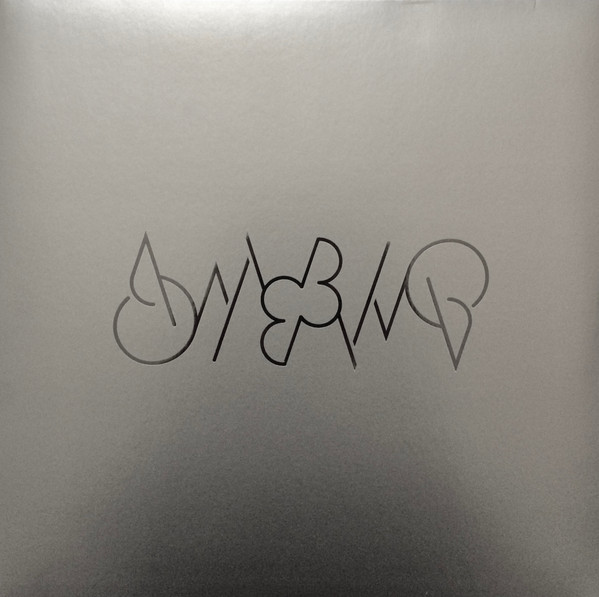
Ambiq
Ambiq 2
Artists
Labels
Catno
AMEL-LP708
Formats
1x Vinyl LP Album Stereo
Country
Release date
Dec 31, 2014
Genres
18€*
*Taxes included, shipping price excluded
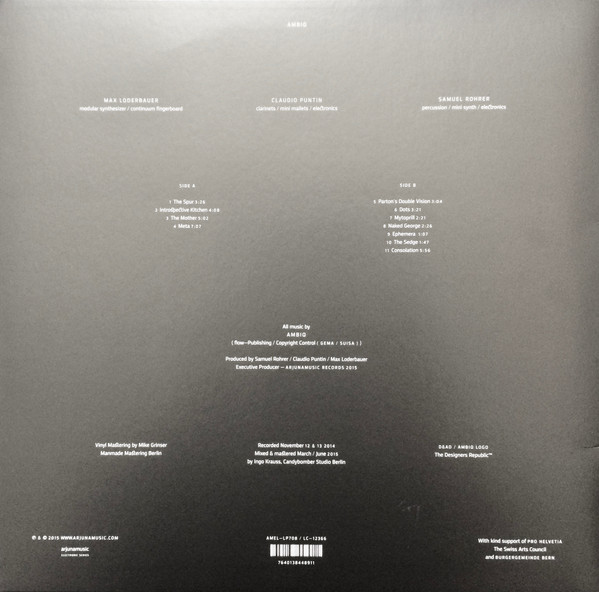
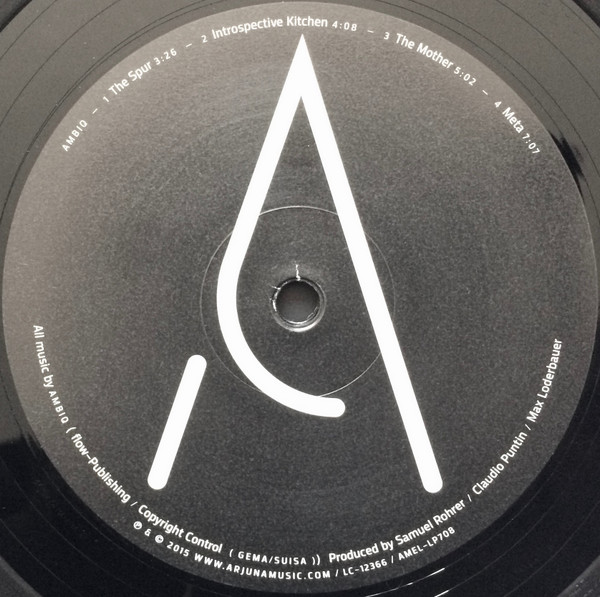
A1
The Spur
A2
Introspective Kitchen
A3
The Mother
A4
Meta
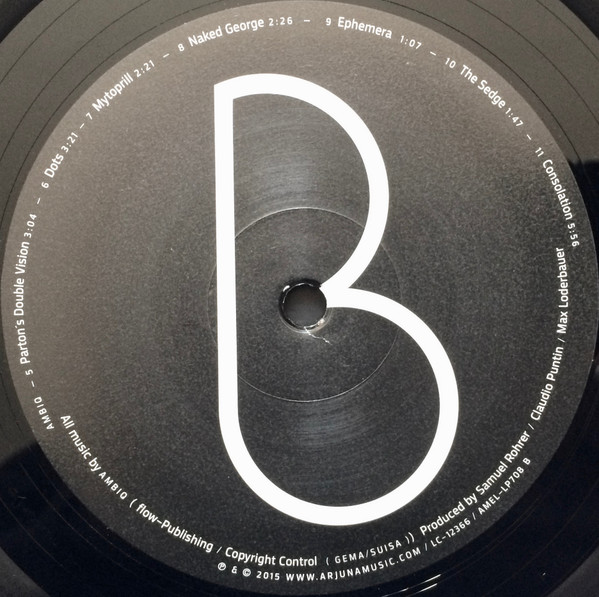
B5
Parton's Double Vision
B6
Dots
B7
Mytoprill
B8
Naked George
B9
Ephemera
B10
The Sedge
B11
Consolation
Other items you may like:

The trained pianist Max Loderbauer, together with Ricardo Villalobos, has just breezily launched the jazz sanctuary of the Munich-based ECM records into the ether as "Re: ECM". On the new adventure he now logically again finds himself working with sanctuaries. For the tool he uses for creating worlds is the finest modular synthesizer in the world, the Buchla 200e.In the glow of this altar-like cockpit, he welcomes the two inspired Swiss musicians, clarinettist Claudio Puntin (also mini-mallets and electronics) and percussionist Samuel Rohrer (also Kaoss pad and other electronics), both of whom have published their own as well as co-operative productions on ECM. With ambiq, they are now exploring remote musical universes on Rohrer's innovative arjunamusic label, with the aim of opening doors of perception to the electronic scene by means of enhanced possibilities of instrumental interaction.

Ambiq, the Berliner instrumental trio of Max Loderbauer, Claudio Puntin and Samuel Rohrer, emerged onto the scene not long ago with a self-titled arjunamusic LP (AM703) of impressive sonic distinctiveness and technical ability. Drinking from a deep pool of influences that includes free improv, early electronic music and spaced-out dub, the trio does what any great ensemble should set out to do: it becomes more than the sum of its parts, a single organism with its own unique expressive vocabulary and perspective. Proving that their debut was no fluke, the ambiq trio has already re-convened for a second full length bubbling over with new timbral combinations, and with a sophisticated interpretation of the ancient art of tension and release.From the opener "The Spur," no time is wasted ushering us to our seats and bringing us to a world where strange new tonalities seem to breathe freely: the nimble percussive shuffle, set in relief against a cascade of detuning electronic tones, is a fascinatingly introspective intro (incidentally, it is actually followed by a piece entitled "Introspective Kitchen," which expands the mood of the preceding track with cleverly delay-effected woodwind, remote organ swells and yet more shivering percussion.) Once the lessons from these preliminary exercises have sunk in, the band then embarks on a more motoring, danceable journey entitled "The Mother": Rohrer's drumming, as always, is taut and confident, while Puntin's clarinet evocatively hovers with a kosmische feel that is all too absent from the realms of "post-rock" and electronics-aided improv.The interplay between Puntin and Rohrer eventually develops into the main dialogue of the album, though the sound events surrounding it change continuously enough to keep this a fully memorable and downright cinematic experience. On "Parton's Double Vision", the lush "space violin" quavers familiar to vintage sci-fi fans play the support role, and the closing "Consolation" features a lulling bed of electronics that elusively shift in character the more attention one pays to them. With all this in mind, the new ambiq LP is as wonderfully cohesive as its predecessor, but never monotonous in the mood it conveys: the miniature piece "Naked George," for example, is as full of humorous melody as the other pieces are full of investigative curiosity. Another short piece, "Mytoprill," is guided by queasy modular synth strains that impart a delirious kind of funhouse ambience.Plenty of music exists for the open-minded, but not all of it has the ability to initiate the process of opening minds in the first place. ambiq does have that ability, and have come up with a musical formula that will melt away the defenses of the most hardened techno fanatic or avant-gardist, seeding new ideas not beholden to any one genre or lifestyle.REMIXES of this album by Margaret Dygas & Thomas Fehlmann will be released in 2016. (AMEL-EP710)

Dark Star Safari is a musical entity comprised of Jan Bang, Erik Honoré, Eivind Aarset, Samuel Rohrer and John Derek Bishop. Their second fulllength offering Walk Through Lightly is the first to feature all five musicians together in the studio from the outset, making for a more organic refinement upon their already established methodology: gradually sculpting distinct songs out of collective improvisations, or using the raw material from initial recordings as the basis for more carefully articulated compositions. The final mix is one that invites few stylistic comparisons to other musical peers, and in fact few comparisons to existing genres. Though this second offering from the project is frosted over with a Scandinavian sense of spatiality andmelancholy, it’s best listened to without considering any origin points, geographic or otherwise: from the opening moments of “Walk Through Lightly,” listeners will feel as if teleported directly into the middle of an enigmatic film-in-progress.The album opener immediately and successfully sets the table for what is to follow. The electronic and acoustic instrumentation is pensive, but not passive, with restrained scrapes and stridulations in the background combining with backwards-looped passages and perlescent or granulated sound effects to better emphasize the carefully arranged latticework of guitar, percussion, strings, and bass. In some places, such as on “Father’s Day” and “Measured Response,” the silences or breaths between passages are pronounced enough to be an instrument in their own right (and an elegant confirmation of the fact that silence is also a conveyor of information). This nuanced production, which wisely opts for intimacy instead of relying on overdone "instant atmosphere generators" like lengthy reverb, provides just enough tension to contrast with the sense of elevation provided by Bang’s vocal contributions: smoky, evanescent, and impressionistic recitations offering not snapshots of specific events, but rather complete emotional environments for the listener to hover through and explore.Within these environments, the lyrical imagery focuses upon coming to grips with sudden transformations on both micro and macro levels (the opening “this was a perfect place / till we lost our way” from “Patria” or the foreboding “Poems that explore / Their silence / Crush their violence / Now their time ends” from “Measured Response.”) It focuses as well upon coming to thresholds or crossings, be they physical crossroads or internal states of mind, or both (see especially the striking turns of phrase from “Murmuration.”) With such things in mind, it’s only natural that there would be consideration of dreaming as well, and indeed four different titles on the LP make different reference to a dream or dream state, seemingly valuing dreams as part of the continuum of consciousness rather than something totally cut off from waking experience.Given the sense of foreboding, anticipation, and even unease that these kinds of subjects often bring with them, the spare and un-hurried music is all the more intriguing, especially when the eponymous finale arrives and the percolating sound bed seems to hint at a coming resolution, but then leaves the listener with more questions than answers. By competently fusing a mature, economical approach to sincerely romantic lyrical themes, Walk Through Lightly is a rare accomplishment.